




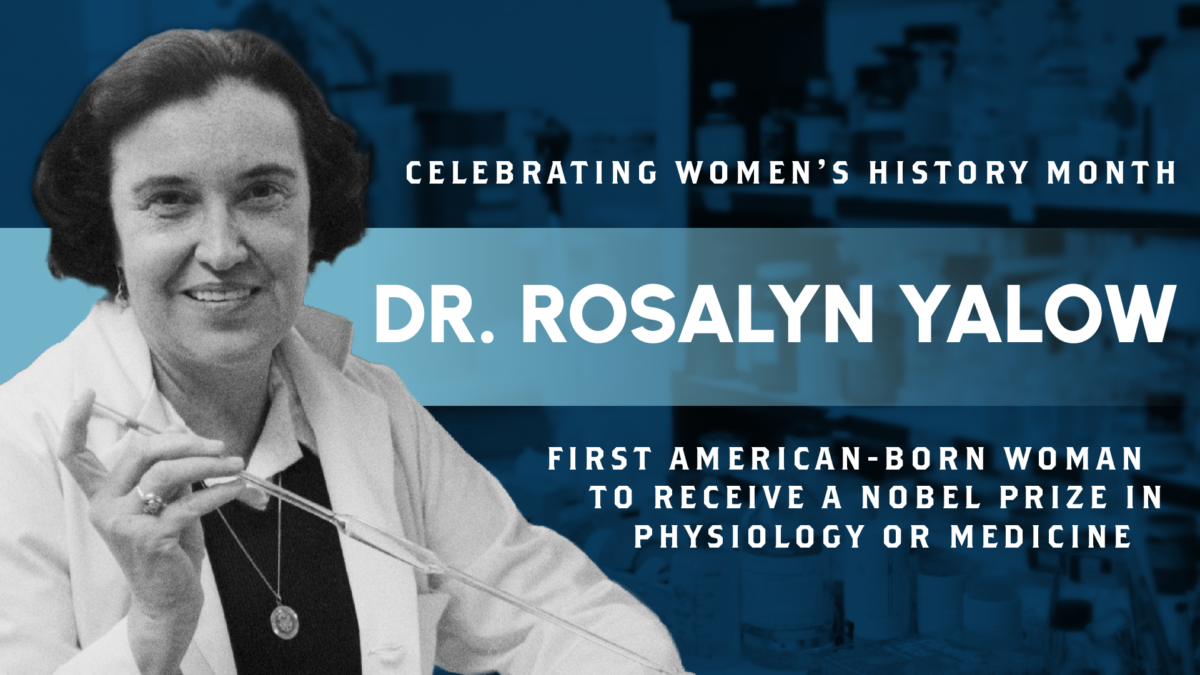
Women’s History Month is a time to celebrate the contributions women have made leading, educating, and inspiring others throughout history. This year, we are spotlighting Dr. Rosalyn Yalow.
Born in 1921 in New York City, Dr. Rosalyn Yalow would become the first American-born woman to be awarded the Nobel Prize in Physiology or Medicine. In her biography provided to the Nobel Prize committee, Yalow wrote of her parents, “Neither had the advantage of a high school education but there was never a doubt that their two children would make it through college.”
Breaking the Mold
It was at Hunter College where Yalow found her passion for physics. Yalow was drawn to the field and was inspired by the potential uses of radioisotopes in the field of medicine. Yalow would go on to graduate school at the University of Illinois at Urbana-Champaign, where she was the only female faculty of 400 professors and teaching assistants. In 1945, Yalow graduated with a Ph.D. in Nuclear Physics.
Of her time in graduate school, Yalow shared in her Nobel Prize biography, “It is evident that the draft of young men into the armed forces, even prior to American entry into the World War, had made possible my entrance into graduate school.” But the impact of World War II was not limited to her acceptance into a graduate program; it also accelerated discoveries within the field of physics.
The Lasting Influence of World War II
Yalow initially found herself working with veterans returning from the frontlines, teaching them in a pre-engineering program. However, teaching was not her passion. Yalow was drawn to the lab. She soon found herself working with the Bronx Veterans Administration Hospital under the Chief of the Radiotherapy Service. It was there that she began collaborating with Dr. Solomon Benson, with whom she would later share the Nobel Prize. Together, they would use wartime discoveries in the field of nuclear fission to explore peaceful application of readily available radioisotopes in the medical laboratory setting.
Though their work in radioisotope tracing was initially focused on thyroid disease and diabetes, they were able to expand their techniques to a wide application through use of smaller peptides. Their development of radioimmunoassay (RIA) is now used to measure minute quantities of biologic substances in human blood and other liquids. This technique is not only used to screen blood donations for infectious diseases, like HIV and hepatitis, but also in the field of cancer screening and in measuring the effectiveness of dosages of antibiotics and other drugs. Yalow and Benson refused to patent the method, ensuring accessibility and continued use.
In 1977, Yalow was awarded the Nobel Prize in Physiology or Medicine for her development of RIA. It is through her work that modern blood screening processes were developed and safe blood transfusions are possible. Her lasting impact is seen daily in the precision processing of We Are Blood’s blood and platelet donations.
Help us honor Dr. Yalow’s legacy this March by scheduling a donation.